
You rolled out CRM training last quarter. Reps sat through it, asked decent questions, and even nodded along when you explained why accurate pipeline data matters for forecasting. Three months later, deal stages are stale, half the activity logged doesn't match what reps actually said happened on their calls, and you're back in a leadership meeting trying to explain why the number in the system doesn't match the number sales believes.
The assumption most B2B leaders make at this point is that the training didn't stick, so the fix is more training, better onboarding, or a stricter mandate. That assumption is usually wrong. Reps aren't skipping the CRM because they forgot how to use it. They're skipping it because the tool takes more time than it gives back, and no amount of repetition changes that math. This is CRM Swamp, one of the five revenue leaks in the Revenue Rewired framework, and it rarely gets fixed with a training slide.
Direct answer
Low CRM adoption is seldom a knowledge problem. Reps who've been trained still avoid the system when logging activity, because it costs them more time than it saves them in actually selling. Before running another training session, inspect whether the CRM was built to help reps close deals or built to give leadership a clean report. If it's the second one, reps will treat it as a chore no matter how well they're trained, and the data will keep drifting stale between review cycles. The primary leak here is CRM Swamp, and the business consequence is a forecast that keeps missing for reasons that have nothing to do with sales performance.
Why training doesn't fix CRM adoption
Training assumes the problem is that reps don't know what to do. In most cases, they know exactly what to do and choose not to do it, because updating the CRM doesn't help them win the deal in front of them. A rep juggling twelve live opportunities isn't going to prioritize a data entry task that only benefits a report they'll never see.
This is why adoption spikes right after a training session and fades within a few weeks. The spike is compliance under observation. The fade is reps returning to their actual priorities once nobody's watching closely. If the underlying tool still takes too long relative to what it gives back, the fade is inevitable, and it'll happen again after the next training push too.
What reps actually weigh when deciding whether to log activity
Every rep runs an informal cost-benefit calculation on CRM updates, whether they'd describe it that way or not. If logging a call takes ninety seconds and produces information that helps them prep for the next conversation, they'll do it. If it takes five minutes, duplicates work they already did in email, and only feeds a dashboard leadership checks on Fridays, they won't.
Reps aren't lazy for making that calculation. They're rational. The system either earns its place in their workflow or it gets treated as overhead, and overhead is the first thing that gets skipped when a pipeline is full and the quarter is tight.
The difference between a CRM built for reps and one built for reporting
A CRM built for reps surfaces information they need in the moment: next steps, deal history, what was promised on the last call. A CRM built for reporting exists to answer questions leadership asks in a QBR, and reps interact with it only because they're told to.
Most CRM Swamp problems trace back to this design gap. The fields required at each stage were added because someone in leadership wanted visibility, not because a rep needed that information to move the deal forward. Multiply a handful of low-value required fields across every deal a rep touches, and you get a system that feels like paperwork instead of a selling tool.
How to spot this before it shows up in the forecast
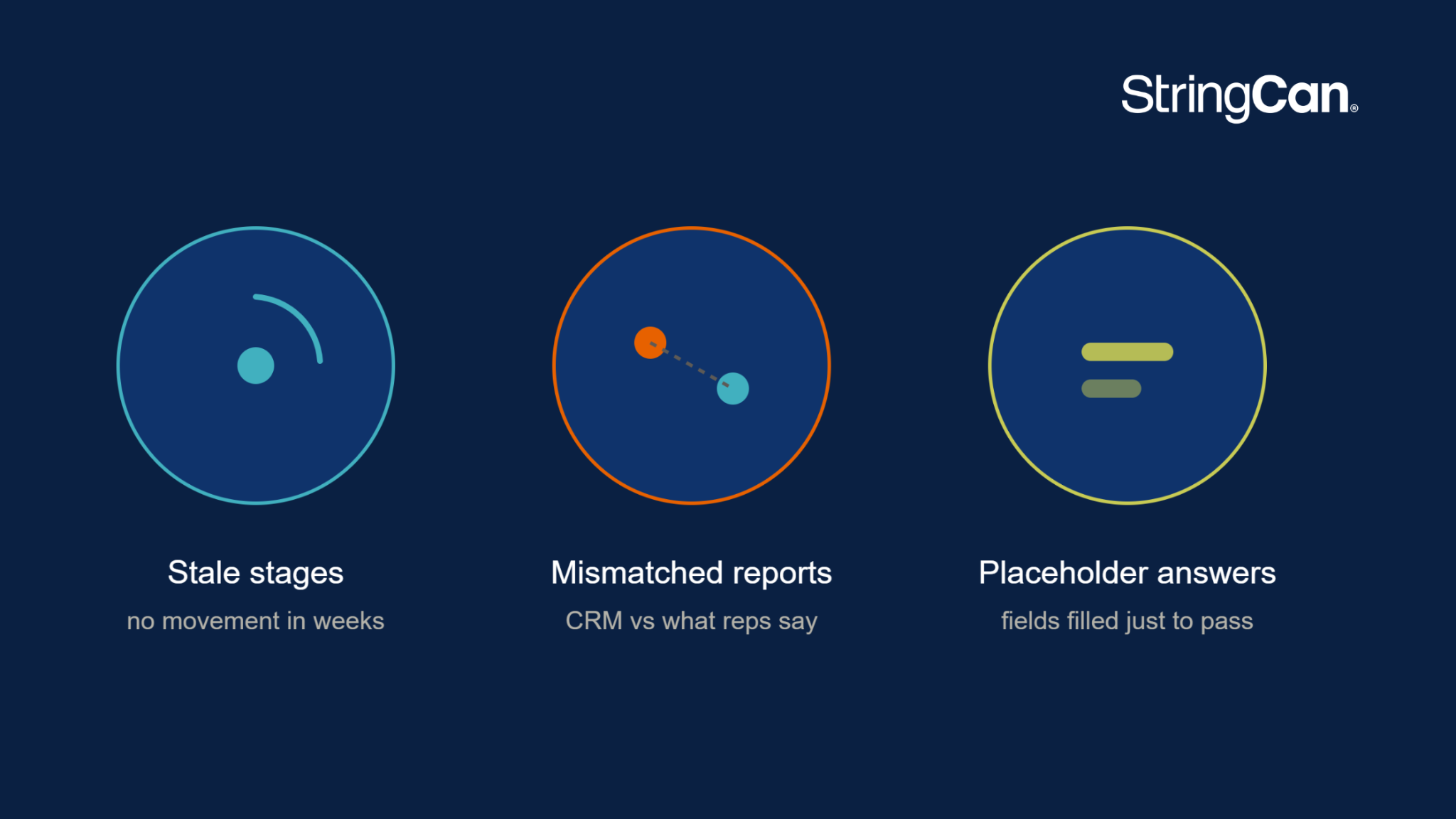
Don't wait for a forecast miss to find out adoption has quietly broken down. A few signs show up earlier if leadership knows where to look. Deal stages that haven't moved in weeks despite active conversations happening outside the system are one signal. A gap between what reps report verbally in pipeline review and what the CRM shows is another. Required fields that get filled with placeholder answers just to move past them are a third.
If any of these are showing up in your pipeline right now, the CRM itself probably isn't broken. The design of what it asks reps to do is.
What actually improves adoption long term
Fixing this usually starts with cutting required fields down to what reps actually need to sell, not what leadership wants to see in a report. Pipeline stages should reflect real buyer behavior, not internal process checkpoints that only make sense from a leadership seat. And any reporting leadership needs should come from data reps were already going to enter for their own benefit, not from extra fields bolted on top.
This is rarely a one-meeting fix. It's usually a structural review of how the CRM is built, who it's built for, and whether the workflow matches how reps actually sell. That's a Revenue Flow conversation, not a training conversation, and it's exactly the kind of pattern StringCan maps in a Growth System Session.
If this pattern feels familiar, a Growth System Session can help map where revenue is leaking, what's causing it, and what should be fixed before adding more training or more mandates. Contact our team if interested in guidance.
FAQ
Why do sales reps avoid updating the CRM?
Reps avoid the CRM when logging activity takes more time than it gives back. If the required fields exist mainly to serve a leadership report instead of helping the rep sell, most reps will deprioritize it, especially when their pipeline is full and time is tight.
Is low CRM adoption a training problem?
Rarely. Most reps already know how to use the system after training. The real issue is usually that the CRM wasn't designed around what reps need to close deals, so the tool feels like overhead instead of something that helps them win.
How do you improve CRM data entry compliance?
Start by cutting required fields down to what genuinely helps a rep sell, not what leadership wants visibility into. Adoption improves when the system gives reps something useful in exchange for the time they spend entering data.
What makes reps actually use a CRM consistently?
Consistency comes from the CRM earning its place in a rep's daily workflow. When updating a deal helps them prep for the next call or remember what was promised, they'll do it without being reminded. When it only feeds a report they never see, they won't.
If this pattern feels familiar, a Growth System Session can help map where revenue is leaking, what's causing it, and what should be fixed before adding more activity.