
Your team sent out more proposals this year than last year, and to everyone’s surprise you won fewer of them. Your senior estimator spent a weekend on a bid for a buyer nobody had met. When the win rate comes up in the leadership meeting, the usual answer is that the proposals need sharper pricing and a stronger executive summary.
That's rarely where the problem starts. In most companies I talk with, the win rate gets decided when someone says yes to an RFP without a real reason to believe the company can win it. In Revenue Rewired, the framework we built at StringCan to diagnose where revenue leaks, we call this the Volume Trap. A stack of submitted bids feels like pipeline, but a lot of it is cost the company never gets back.
Direct answer
A low proposal win rate is usually a go/no-go problem before it's a writing problem. If your team responds to most RFPs that arrive, inspect the decision that happens before the proposal: who approves a bid, what criteria they use, and whether anyone knew the buyer before the RFP showed up. Don't assume better proposals or more submissions will raise the number. This is the Volume Trap, where proposal activity stands in for qualified pipeline. The cost shows up as margin lost to senior and billable hours and a forecast padded with bids that were never likely to close.
What a go/no-go decision is, and why most teams skip it
A go/no-go decision, which some teams call bid/no-bid, is a deliberate check on whether an opportunity is worth pursuing before you put hours into it. Most companies say they have one, but very few have one that anybody follows.
What they have instead is momentum. An RFP lands, someone asks, "Should we go for this?" and nobody wants to be the person who passed on revenue. Since nobody is assigned to say no, the answer defaults to yes, even though a weak opportunity costs as much to answer as a strong one.
Signs your team is bidding on too much
Pull the last 12 months of proposals and see how many of these fit:
- Proposals submitted went up, and wins stayed flat or dropped.
- Nobody recorded why most bids were lost.
- A good share of RFPs came from buyers your team had never spoken with.
- The bids you really wanted got rushed because the team was stretched.
- Leadership reports "proposals out" as a sign of a healthy pipeline.
If three or more fit, fix the go/no-go decision before the template.
What actually drives a low proposal win rate
A bid gets lost in the proposal, the price, or the opportunity itself. Leadership teams tend to work on the first two because they're easy to see.
The opportunity is harder to look at, because it means admitting the bid shouldn't have gone out, and it's where I usually find the leak. If the buyer already had a preferred vendor or only needed a third quote for procurement, polish won't change the outcome.
This is the point I'd defend in any CEO conversation. A company that bids on fewer RFPs, chosen with discipline, tends to win more work and spend fewer hours doing it. When leadership counts proposals sent instead of wins by fit, the scoreboard rewards volume, which is the Metrics Misfire leak sitting right beside the Volume Trap.
A go/no-go scorecard to use before the next RFP
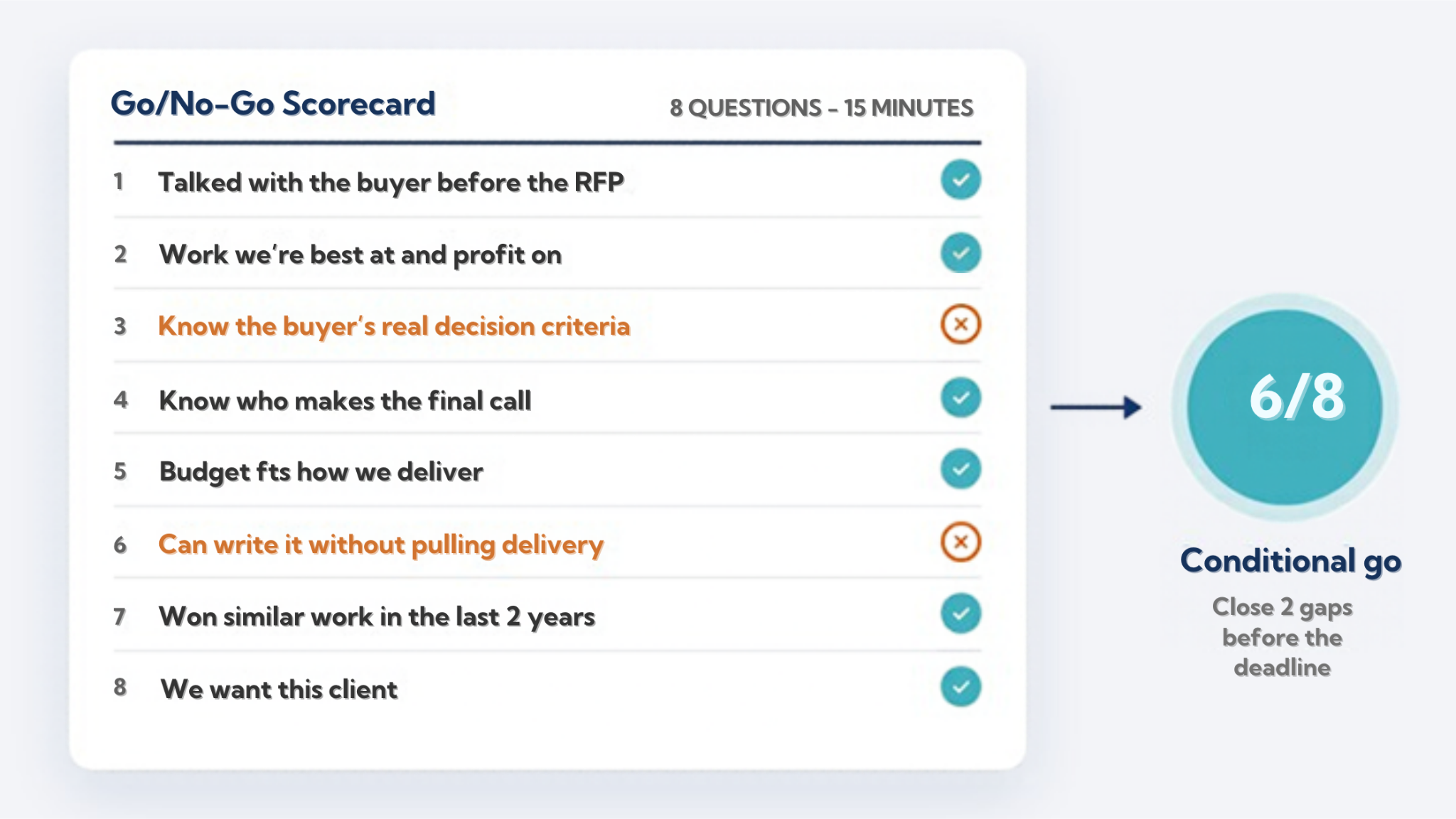
Run this in about 15 minutes before committing to a response. Answer each question yes or no.
- Did we talk with this buyer before the RFP was issued?
- Is this work we're best at and most profitable doing?
- Do we understand the buyer's real decision criteria beyond what's written?
- Can we name who makes the final call and what they care about?
- Is the budget realistic for how we deliver?
- Have we won similar work at this size in the last two years?
- Can we write a strong response without pulling people off active client work?
- If we win, do we want this client?
Fewer than five yeses is a pass, unless leadership can name a strategic reason out loud. Five or six is a conditional go, with one person responsible for closing the gaps before the deadline. Seven or eight is a full go. Treat those thresholds as a starting point and adjust them after a quarter of tracking.
The scorecard only works if one person, usually the CEO or the head of business development, owns the decision and is allowed to say no. Without that, it turns into paperwork and the default yes comes right back.
What to track so the win rate improves every quarter
Record a few fields in your CRM for every opportunity, including the ones you pass on:
- Scorecard result and who made the call
- Win, loss or pass, with a short reason
- Hours spent on the response
- Whether there was a relationship before the RFP
After a quarter or two, you'll see which kinds of bids you almost never win and what a lost proposal costs in hours. That's the Adapt stage of Revenue Flow, StringCan Interactive’s method for improving a growth system with real performance data before adding activity.
FAQ
What is a good proposal win rate for a B2B company?
It depends on your industry, contract size and how many bids come from existing relationships, so outside benchmarks only go so far. The more useful number is your own win rate split by fit. Compare bids where you knew the buyer before the RFP against cold RFPs, and the gap between them will tell you more than any industry average.
Who should make the go/no-go decision on an RFP?
One named person with the authority to say no, usually the CEO or the head of business development. Sales and delivery leaders should weigh in on fit and capacity, but a decision everyone shares tends to default to yes. If the CEO still approves every bid, write the criteria down so the call can move to someone else.
Should you respond to an RFP when you have no relationship with the buyer?
Sometimes, but treat it as the exception. A cold RFP often means the buyer has already shaped the requirements around another vendor. Before responding, try to get a conversation with the decision-maker during the question period. If you can't, and the scorecard comes in low, passing is usually the better use of your team's time.
How do I know if the Volume Trap is affecting more than our proposals?
Proposals are where it's easiest to see, but the same pattern shows up in campaigns, outreach and trade show leads. StringCan's Revenue Leak Finder is a short diagnostic that shows where revenue may be leaking. If several leaks show up together, a Growth System Session maps what's causing them and what to fix first.
Start with your last 12 months of bids and the scorecard above. Then take the Revenue Leak Finder. If your result feels familiar, send it to me and I'll tell you where I'd inspect first.
Jay Feitlinger is the CEO of StringCan Interactive and the creator of Revenue Rewired.