
Somebody gets back from the show and reports the number.
Two hundred scans. Three hundred. Maybe more. The room reacts the way rooms react when a number sounds like progress.
Six weeks later, ask that same room to name one deal that came out of it and the answer gets much quieter.
That is where a lot of B2B trade show marketing breaks. Not in the booth. Not because the event was bad. Not because people did not stop by. It breaks because the company treated a scan list like a pipeline before anyone defined what a qualified pipeline was supposed to look like.
A badge scan proves somebody walked past your booth, had a conversation, grabbed something, or let your team capture their contact information. That is useful. It is not revenue. It is not an opportunity. It is not even always a lead.
It is an input. What happens next decides whether the show was a channel or just an expensive calendar event.
What a badge scan actually proves
A badge scan proves one thing: you captured someone’s contact information.
That’s it.
It doesn’t prove they’re a good fit. It doesn’t prove they have a real need, the budget, or the authority to buy. And it definitely doesn’t prove they’ll remember your conversation three days later, once they’re back at work dealing with everything that piled up while they were away.
This is where the Volume Trap shows up inside event marketing. The company sees volume and feels movement. More scans feel better than fewer scans, so the team naturally treats the larger number as success.
But more scans usually mean a bigger list. They don’t automatically mean more qualified pipeline.
That distinction matters because sales teams learn quickly. If most event contacts are weak, unclear, cold, or unqualified, sales stops trusting the whole category. Then the one real buyer buried in the list gets treated like everyone else.
That is the expensive part. You do not just waste event spend. You train the system to ignore the very signal the event was supposed to create.
Why scan count becomes the metric by default
Scan count wins because it arrives first.
The event ends. The team is tired. Leadership wants to know how it went. Marketing has a number ready. Sales may have stories. The booth looked busy. Everyone wants to feel like the spend was justified.
So the scan count becomes the report.
The problem isn’t that scan count is useless. The problem is that it gets promoted into a success metric because the company didn’t agree on a better one before buying the booth.
This is Metrics Misfire. The business measures the activity because the revenue outcome is harder to see. Then the next booth decision gets made on the number that was easiest to produce, not the number that predicts revenue.
That is the same pattern we talk about in Revenue Rewired. B2B companies often think the fix is more activity. More leads. More scans. More campaigns. But more activity added to a weak growth system usually creates more noise before it creates more revenue.
If you want the deeper version of that problem, read the piece on chasing more leads backfires. The same issue shows up here, just with a booth invoice attached.
The two weeks after the show
The most important part of the trade show often starts after everyone gets home.
That’s also the part most companies barely manage.
The scan list gets exported. Someone uploads it to the CRM. A few names get recognized. A few follow-up emails go out. Maybe sales gets a spreadsheet. Maybe marketing starts a nurture sequence. Maybe everybody assumes someone else is working it.
By the second week, buyer context is already fading. The conversation that felt strong at the booth has turned into one more vague CRM record. The salesperson sees a name, title, company, and maybe a note that says “interested.” That is not enough to prioritize against live opportunities already in the pipeline.
Speed matters. Research on lead response has consistently shown that contact and qualification rates degrade quickly when follow-up slows, with the well-known MIT and InsideSales lead response study showing much stronger contact and qualification odds when follow-up happens within minutes instead of waiting. The exact numbers may not transfer perfectly to every trade show environment, but the business lesson does: buyer context has a half-life. [1]
For events, the issue is not only speed. It is speed plus context plus ownership.
-
Who owns the list on Monday morning?
-
Which contacts are worth direct sales follow-up?
-
Which ones belong in nurture? Which ones are not a fit?
-
What does sales need to know from the booth conversation to make the follow-up relevant?
If those answers are not clear by Friday, the show is already leaking.
How to tell if events work for your business or just for your calendar
Trade shows can absolutely work for owner-led B2B companies.
Manufacturing, industrial services, commercial construction, logistics, and complex service businesses often sell through trust, technical fit, timing, and relationships. Events can create useful proximity to the right buyers, partners, vendors, and influencers.
But the event itself is not the system.
The system is what happens before, during, and after the event. Before the show, the company defines what qualified means and who it wants to meet. During the show, the team captures context instead of contact information. After the show, ownership, follow-up, and CRM visibility determine whether the list becomes part of the pipeline or disappears.
Some 2026 event marketing benchmark sources report that disciplined event teams track pipeline, opportunity creation, attribution, and closed-won influence instead of stopping at attendee or scan volume. That should be the standard. Not because benchmarks are perfect, but because they point to the right question: did the event create qualified revenue movement or just activity? [2]
If your company cannot answer that, you do not have an event ROI problem yet. You have a measurement problem.
What to define before you commit to the next booth
Before you sign the next contract, define success in language sales, marketing, and leadership can all use.
Not “good conversations.” Not “brand exposure.” Not “strong traffic.” Those may matter, but they cannot carry the renewal decision by themselves.
Define the outcome. For example:
- How many target accounts should we meaningfully engage?
- How many qualified follow-up conversations should be created?
- How many contacts should enter the pipeline with a defined next step?
- What CRM fields must be completed for every priority contact?
- Who owns follow-up by segment?
- What will we review two weeks after the show?
- What number would make us renew, reduce, or cut this event next year?
Those questions do not make the event less creative or less human. They make it accountable.
They also protect your team. Marketing should not be asked to prove value from a show that had no success definition. Sales should not be handed a cold list with no context and then blamed when nothing happens. Leadership should not renew a five-figure or six-figure line item because the scan count sounded good in the Monday meeting.
The Booth Renewal Test
Take this into the next leadership meeting before you approve the next booth.
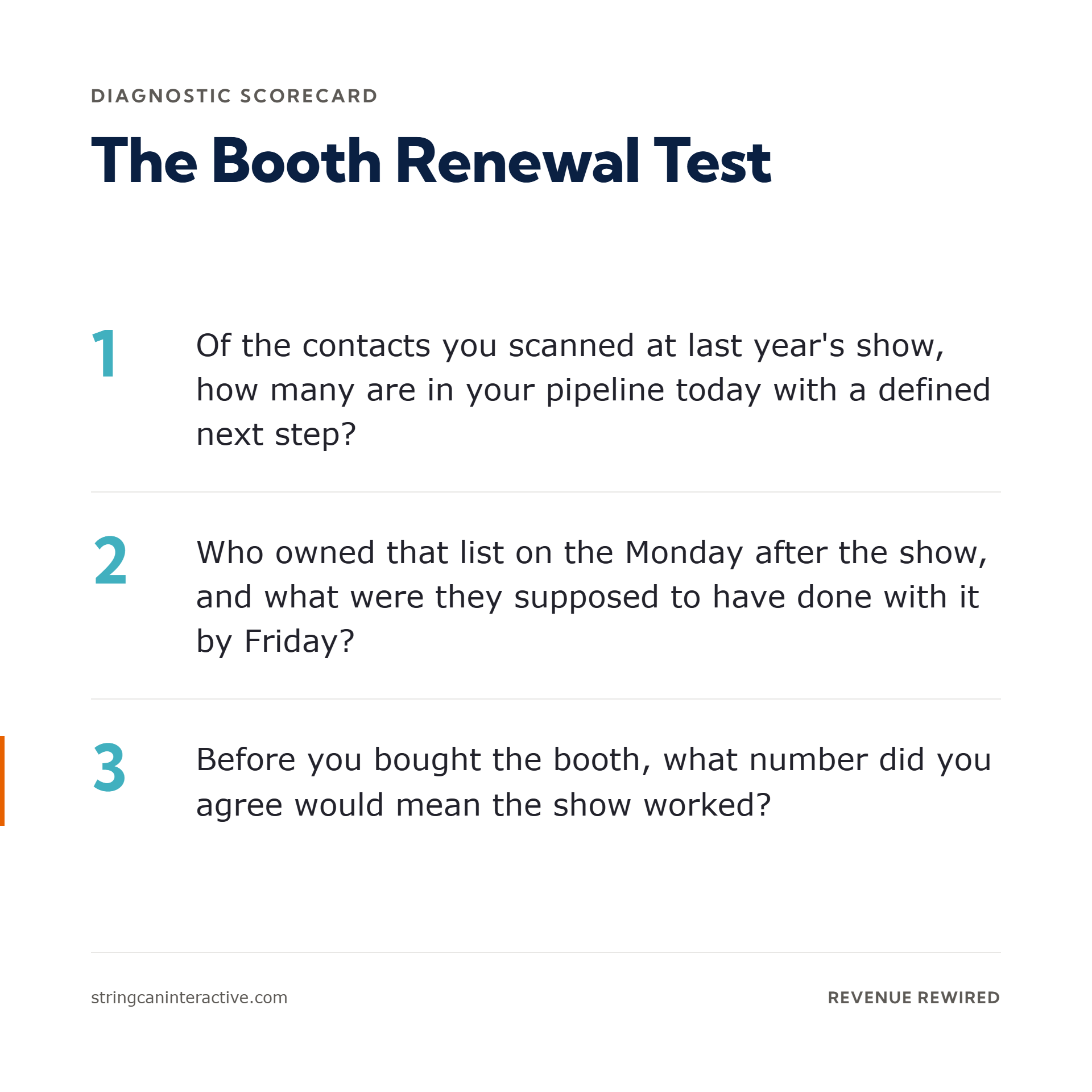
1. Of the contacts you scanned at last year’s show, how many are in your pipeline today with a defined next step?
2. Who owned that list on the Monday after the show, and what were they supposed to have done with it by Friday?
3. Before you bought the booth, what number did you agree would mean the show worked?
Question three is the one that usually exposes the leak.
If nobody agreed on the outcome before the booth was purchased, scan count was never really a measurement. It was a placeholder.
The inspection to run on last year’s show before you renew
Do not start with the scan count.
Start with the Monday after.
Pull the list from last year’s show. Look at the CRM record for each meaningful contact. Check whether there was an owner, a stage, a next step, a meeting, an opportunity, or a reason the contact was disqualified.
Then separate the list into four groups:
Qualified opportunity created
Qualified but no next step
Nurture or future timing
Not a fit
If most of the list is sitting in a fifth category called “unknown,” the show did not give you a pipeline answer. It gave you a visibility problem.
That is where Revenue Flow comes in. Align on the outcome before the booth is purchased. Accelerate by fixing qualification, handoff, and CRM visibility. Amplify the event only after the system can convert and measure what it captures. Adapt after the show by reviewing what created movement and what did not.
The show may deserve a bigger investment. It may deserve a smaller one. It may need a different audience, a different team, a different pre-show motion, or a different follow-up process.
But the decision should not be made from a scan count.
If question three in the Booth Renewal Test made your meeting go quiet, that is usually not just a trade show problem.
It is a revenue leak.
Start with the Revenue Leak Finder. It will help you see whether the issue is Volume Trap, Metrics Misfire, Ghost Handoff, CRM Swamp, or Reactive Rhythm before you spend more money creating more activity the system may not be ready to convert.
FAQ Section for SEO, AEO, and Schema
Do trade shows generate real B2B pipeline?
Yes, trade shows can generate real B2B pipeline, but only when the company defines qualified pipeline before the event, captures buyer context at the booth, assigns follow-up ownership immediately, and tracks contacts through CRM stages to real opportunities. A scan list alone is not pipeline. It is only the raw material.
How should we measure trade show ROI?
Measure trade show ROI by connecting event cost to qualified opportunities, pipeline created, pipeline influenced, sales meetings, conversion movement, and closed revenue. Scan count can help explain activity, but it should not be the success metric leadership uses to renew the booth.
What should happen to trade show leads in the first week?
Every trade show contact should be reviewed, qualified, assigned, staged, and given a next step in the first week. Priority contacts should not sit in a generic nurture list without sales context. The Monday-after ownership question matters as much as the event itself.
Is a badge scan a lead?
A badge scan is not automatically a lead. It is a contact capture. It becomes a lead only after fit, need, buying role, timing, and next action are confirmed.
How do you decide whether to renew an event?
Before renewing an event, inspect last year’s list. Look for contacts that became qualified opportunities, meetings, pipeline, or revenue. Then ask whether the team defined success before the booth was purchased. If the only clear number is scan count, the renewal decision is being made from activity instead of revenue evidence.