
The 2027 marketing budget usually shows up as a spreadsheet with this year's number, a 10% increase, and one new channel somebody wants to try. Then the CEO asks a fair question: which of this year's dollars turned into closed deals? The room gets quiet, and the meeting turns into a negotiation over the total instead of a decision about where the money should go.
The assumption underneath that meeting is that pipeline is a spending problem. Spend more at the top, and you'll get more at the bottom. But if leads stall after they come in, or opportunities keep dying in the same stage, a bigger budget sends more buyers into the same break. In Revenue Rewired, the framework I built at StringCan to diagnose where B2B companies lose revenue, that's the Volume Trap: activity keeps growing while qualified pipeline doesn't.
So before you approve next year's number, find the leak this year's budget was already funding.
Direct answer
Set your 2027 B2B marketing budget from conversion math, not from last year's spend or an industry percentage. Start with the revenue target and work backward through your actual win rate, opportunity rate, and lead-to-opportunity rate, then compare each one to what happened this year. The stage where the rate broke is where the first dollars should go, and it's often a follow-up, qualification, or sales process fix rather than more top-of-funnel activity. Don't assume more leads will produce more revenue if conversion is already leaking. That's the Volume Trap, and funding it raises your cost per closed deal while pipeline stays flat.
Signs your 2027 marketing budget is funding a leak
If three or more of these sound familiar, the budget conversation is starting in the wrong place.
- Nobody can tie this year's spend to closed revenue by source.
- Lead volume went up this year, but opportunities created stayed flat.
- Sales says the leads are weak, and marketing says sales isn't following up.
- Win rate is a gut number, not a report anyone pulls monthly.
- Deals pile up in one stage and sit there for more than a quarter.
Each one points to a conversion problem between first touch and closed deal, and a larger budget doesn't fix any of them.
What pulls a budget back toward last year's number
Last year's spend is the easiest number to defend because it already got approved once. The trouble is that it anchors the whole conversation to inputs like channels, retainers, events, and headcount, when the CEO is really asking about outcomes.
This is where Metrics Misfire feeds the Volume Trap. If the monthly report tracks traffic, MQLs, and cost per lead, the budget gets built to buy more of those things. Nobody planned it that way.
Recent budget benchmarks can be useful context. Gartner’s 2026 CMO Spend research puts average marketing budgets at 7.7% of company revenue, but a benchmark still can’t tell you whether your specific system can convert the demand that budget creates.
The reporting never asked what happened to leads after sales got them, so the budget doesn't either.
A few years ago, I was in a budget conversation with a mid-market B2B company that was ready to put more budget into paid media and another lead source because the pipeline was feeling light. On paper, that sounded reasonable, but when we looked at the numbers, the real break wasn’t lead volume. Leads were coming in, but follow-up was inconsistent, sales were unclear on what counted as qualified, and several real opportunities were sitting in the same stage with no clear next step.
That changed the budget conversation immediately. Instead of funding another channel, the first move was to tighten response ownership, clean up the qualification rules, and make their HubSpot CRM show where deals were actually getting stuck. Once that was fixed, the company could make a smarter decision about where new marketing dollars belonged. That’s the point most teams miss: a bigger budget doesn’t fix a broken revenue path. It just makes the revenue leak more expensive.
Percentage of revenue or conversion math: which should set the number?
Percentage-of-revenue benchmarks are a useful sanity check on whether your spend is far out of range for companies your size. They can't tell you whether your system can convert what that money buys, and that's what decides whether 2027 beats this year.
Two B2B companies can spend the same share of revenue on marketing and get completely different results. One replies to inbound leads the same day and has clear stage definitions in the CRM. The other lets leads sit for a week and runs a forecast nobody trusts. Only one of them should be spending more next year.
Build the budget backward with a reverse funnel check
Here's the check I'd run before any marketing budget gets approved. It takes an afternoon with your CRM and whoever owns sales reporting.
- Divide the 2027 new revenue target by your average deal size to get the deals you need.
- Divide deals needed by this year's actual win rate to get the opportunities you need.
- Divide opportunities by your real lead-to-opportunity rate to get the qualified leads the plan requires.
- Compare each rate to last year and to what the forecast assumes.
- Circle the stage where the actual rate falls furthest short of what the plan needs.
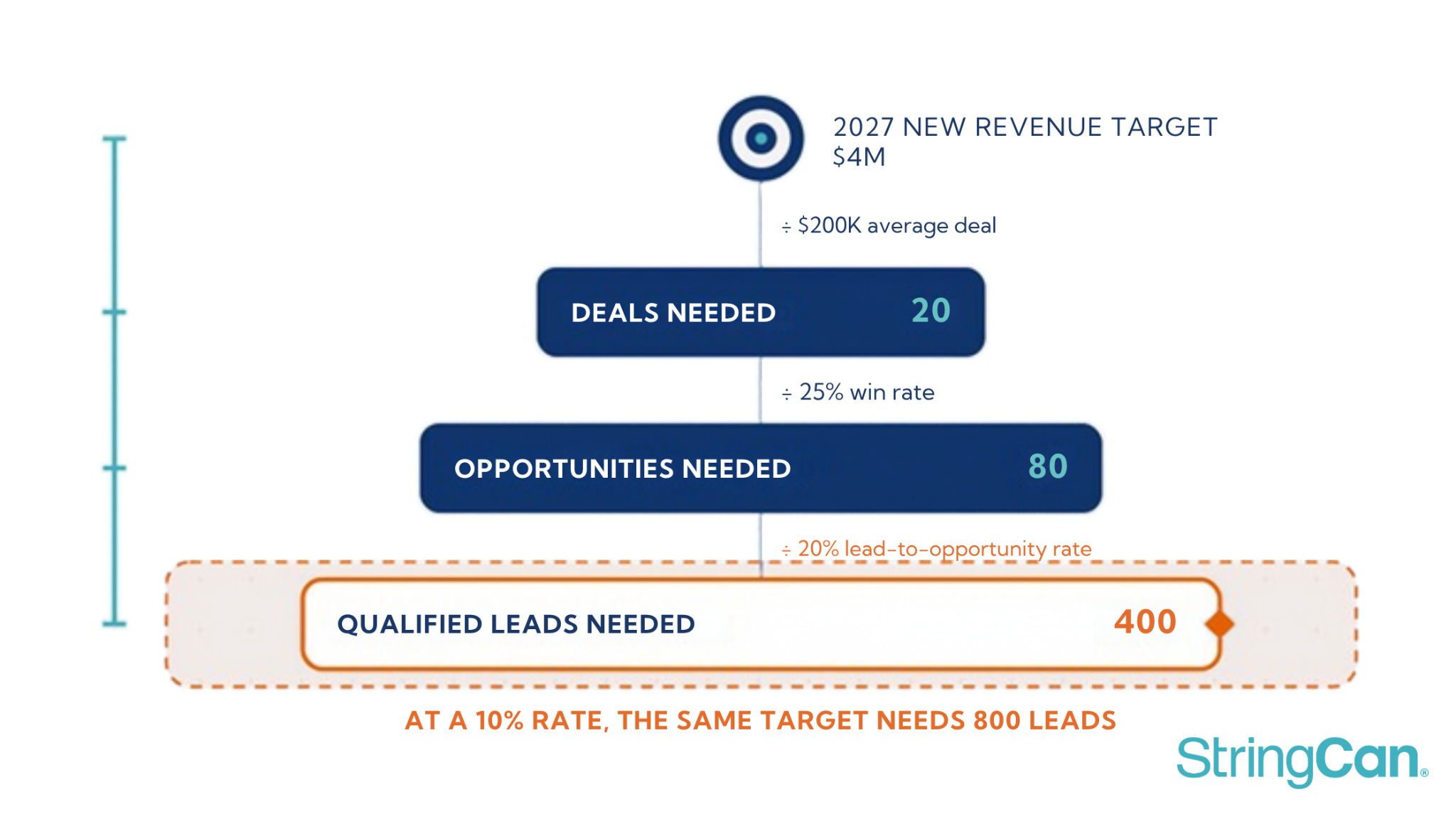
Here's how it plays out. Say the target is $4M in new revenue and your average deal is $200,000, so you need 20 deals. At a 25% win rate, that's 80 opportunities, and if 20% of qualified leads become opportunities, you need 400 leads. Now say the lead-to-opportunity rate is really 10% because follow-up is slow. You'd need 800 leads to hit the same number, and buying twice the leads is an expensive way to cover a follow-up problem you could fix for far less.
That circled stage is where the first dollars go.
What to fix before adding new marketing spend
Here's the part agencies selling retainers rarely say. Some B2B companies should hold next year's marketing budget flat until one conversion rate is fixed. If leads wait days for a first reply, fund response ownership before you fund another channel. If deals stall in the same stage every quarter, tighten the exit criteria before you buy more pipeline to push through it.
That's the order we follow in Revenue Flow, the methodology behind StringCan's work with B2B companies. We align on the target and on what counts as a qualified opportunity, then fix the leak we found. Budget to amplify demand comes after that, when the new dollars finally have somewhere to go.
FAQ
How much should a B2B company spend on marketing in 2027?
There isn't one right percentage. Benchmarks can show whether your spend is far out of range, but the right budget comes from your revenue target and your actual win rate, opportunity rate, and lead-to-opportunity rate. If one of those rates is broken, the smarter move may be holding spend flat and fixing it first.
Should I increase marketing spend if pipeline was flat this year?
Not until you know why it was flat. If lead volume rose and opportunities didn't, the problem is conversion, and more spend will raise your cost per closed deal. If lead volume fell while conversion held steady, a targeted increase can make sense. The reverse funnel check shows which situation you're in before the budget gets approved.
What is the Volume Trap in B2B marketing?
The Volume Trap is one of the five revenue leaks in StringCan's Revenue Rewired framework. It happens when marketing activity and spend keep climbing while qualified pipeline stays flat. It usually hides a conversion problem downstream, like slow follow-up or deals stalling in one stage. Budget season is when it gets expensive, because the fix people reach for is buying more of the same activity.
How do I find where revenue is leaking before budget approval?
Run the reverse funnel check against this year's actuals and circle the stage that falls furthest short. For a faster read, StringCan's Revenue Leak Finder walks B2B leaders through the five revenue leaks and shows which ones are likely costing them pipeline. For the full picture, a Growth System Session maps where revenue is leaking and what to fix first.
Before your 2027 budget gets approved, take the Revenue Leak Finder. If your result feels familiar, send it to me, and I'll tell you where I'd inspect first.