
Six months after the new website launches, someone pulls the numbers. Traffic is up, the pages finally look like the company you've become, and prospects compliment the site on sales calls. Then the CEO asks how many qualified opportunities the website has produced since launch, and it's the same handful of form fills as before, plus a bunch of spam, vendors, and job seekers.
The redesign assumed the old site was the reason leads weren't coming in. Sometimes that's true, but often the site was never the bottleneck. Buyers who weren't ready to talk had nowhere useful to go, buyers who were ready filled out a form nobody owned, and no one could say which pages produced revenue. In Revenue Rewired, the framework we built at StringCan to diagnose where B2B companies lose revenue, that's the Volume Trap: traffic and activity climb while qualified pipeline stands still.
A redesign can make your site faster, clearer, and easier to trust. It won't touch the conversion path, the handoff behind the form, or the reporting that shows which pages produce pipeline, and those are what decide whether new traffic turns into revenue.
Where does the leak sit?
A website redesign won't fix a pipeline problem when the leak sits behind the site. Before you fund one, inspect three things on the site you already have: whether buyers who aren't ready to talk can take a useful next step, who owns each form submission and how fast a real person responds, and whether you can report pipeline and closed revenue from website leads for the last 12 months. Don't assume better design will convert better on its own. If any of those is broken, the new site sends more traffic into the same leak. That's the Volume Trap, and it raises your cost per qualified opportunity while pipeline stays flat.
Signs the website problem isn't the design
If three or more of these sound familiar, the redesign conversation is starting in the wrong place.
- Traffic went up after the last launch, and qualified opportunities from the site didn't.
- Contact Us or Request a Quote is the only conversion point on the site.
- A noticeable share of form fills come from vendors and job seekers.
- Form submissions land in a shared inbox or an unassigned queue in the CRM.
- Sales says website leads aren't worth chasing, and no one has checked how fast those leads heard back.
New photography, a cleaner layout, and a faster theme can all be worth doing. They just don't change anything on that list.
What a better-looking site still can't do
Your buyers do a lot of their research before they talk to anyone. If the only offer on your site is a sales conversation, you've built for the few visitors who are ready this week, and everyone else leaves. Some come back months later through a competitor who gave them something useful, like a pricing range or an assessment.
The second break is behind the form. When a submission goes to a general inbox or sits unassigned in HubSpot, a buyer who was ready to talk waits, and a day of silence is long enough for them to call the next firm on their list. That's the Ghost Handoff, and a redesign doesn't change who owns the response clock.
Then there's reporting. If the site gets judged on sessions, bounce rate, and time on page, every one of those can improve while pipeline stays flat. Without lead source tied to opportunities and closed deals, you can't tell which pages earn their keep, so the new site gets designed around opinions about the old one.
I’ve seen this movie more than once. A company finally launches the new site, everyone loves how it looks, and for a few weeks there’s this little victory lap around cleaner pages, better messaging, and more traffic.
Then someone asks the uncomfortable question: “So why aren’t better leads showing up?” That’s when the real problem gets exposed. The site wasn’t broken because it was ugly. It was broken because the buyer path was fuzzy, the form dropped into a black hole, and no one could clearly say what happened after someone raised their hand.
Three tests to run before you fund a redesign
We design and build websites at StringCan, and I'd still ask any CEO to run these before signing a redesign proposal, including one from us. Together they take about an hour, not counting however long the form test leaves you waiting.
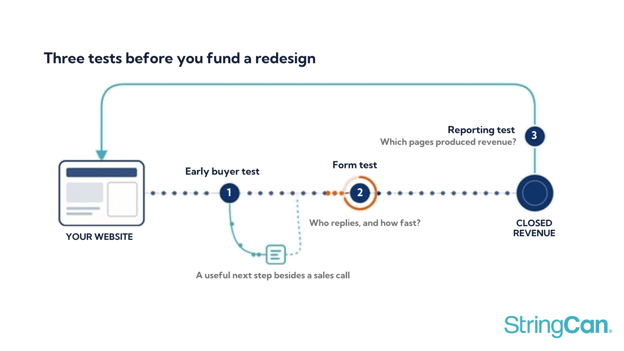
- The early buyer test. Visit your site as someone three months from a decision. Is there anything worth taking besides a sales call, like a pricing guide or a diagnostic?
- The form test. Fill out your own contact form on a Tuesday morning. Time how long it takes a real person to respond, and note who it was.
- The reporting test. Ask for the last 12 months of website leads tied to opportunities and closed revenue. If no one can produce that report in a day, you won't be able to prove a new site works either.
If a test fails, fix it on the site you have first. Those fixes are smaller and faster than a rebuild, and they give you a baseline to judge the new site against.
When a redesign is the right call
Sometimes the site really is the problem. If it's slow or broken on mobile, if your team can't update a page without a developer, or if the design makes a $30M company look like a $3M one to the buyers you're chasing, a redesign earns its budget.
Even then, I'd sequence it the way we do in Revenue Flow, the methodology behind StringCan's work with B2B companies: align on who the site is for and what counts as a qualified lead, fix the leaks you find, and then amplify with design, content, and traffic. If the redesign is already in next year's budget, run the tests before it's approved, the same way you'd build the 2027 budget backward from conversion rates.
FAQ
How do I know if my B2B website needs a redesign?
Redesign when the site itself is the constraint: it's slow or broken on mobile, your team can't update it without a developer, the positioning is outdated, or the design undercuts the size of deals you're pursuing. If none of that applies and pipeline is still flat, run the early buyer, form, and reporting tests first to see whether the leak sits behind the site.
Why does my website get traffic but no leads?
Usually the site offers one next step, a sales conversation, to visitors who aren't ready for it yet. It can also mean the traffic isn't your buyer, which shows up when form fills come from vendors and job seekers. More traffic won't help until the pages that bring visitors in offer something useful to someone still researching.
Does a website redesign hurt SEO?
It can. Changing URLs without 301 redirects, deleting pages that ranked, or dropping content during the rebuild can cost search traffic that took years to earn. A careful redesign maps every old URL to a new one and keeps the pages that bring in buyers, which is easier when you already know which pages produce pipeline.
What should I fix before investing in a new website?
Start with a useful next step for buyers who aren't ready to talk, a clear owner and response time for every form submission, and reporting that ties website leads to revenue. StringCan's Revenue Leak Finder shows which revenue leaks are likely costing you pipeline, and a Growth System Session maps what to fix first before you commit redesign budget.
Before a redesign goes into next year's budget, take the Revenue Leak Finder. If your result feels familiar, send it to me and I'll tell you where I'd inspect first.