
Your average deal age is up six weeks from last year. The pipeline report still shows enough dollars to cover the number. Nobody in the Monday sales meeting can tell you which stage those six weeks came from, so the meeting turns into a deal-by-deal recap and everyone leaves with the same conclusion: buyers are slower right now.
That conclusion is usually wrong, and it's expensive precisely because it can't be acted on. If the market slowed, there's nothing to fix, and you wait. If one stage in your pipeline quietly became a holding pen, there's plenty to fix, and you can do it this quarter.
Here's what I find when I open a client's CRM. The cycle didn't stretch evenly. One stage got sticky, almost always the one with the loosest exit criteria, and the overall average absorbed the damage so cleanly that nobody could see where it happened. That's a CRM Swamp problem. Your data is technically fine. Your visibility isn't.
Direct answer
A longer sales cycle and a stuck deal stage look identical on a summary report and need completely different fixes. To tell them apart, pull two numbers for every stage: stage exit rate, meaning the percentage of deals that have left the stage in any direction, and median time in stage. If cycle time grew evenly across all stages, you may have a real market or deal-mix shift. If one stage shows a falling exit rate and a climbing time in stage, that stage is the problem.
Don't assume it's a rep skill issue. The usual cause is a missing exit criterion, not a missing capability. Left alone, this produces a forecast that always looks adequate and always misses.
What a stuck stage actually looks like
Every pipeline has one stage where deals go to wait. In most B2B companies I look at, it's proposal or verbal commit, because those are the stages where nothing forces a decision. A deal enters, the rep sends the document, the buyer says they're reviewing internally, and then the deal just exists. Nobody disqualifies it, and nobody advances it. It ages.
What makes this hard to catch is that a waiting deal still counts. It sits in the pipeline value report at full value, so the total looks healthy while the composition rots underneath it. You can be sitting at 3.5x coverage with a third of those dollars untouched for ninety days.
Ask your sales leader one question at the next pipeline review: what has to be true for a deal to leave this stage? If the answer is some version of "when the buyer gets back to us," you've found the holding pen.
Why the average hides it
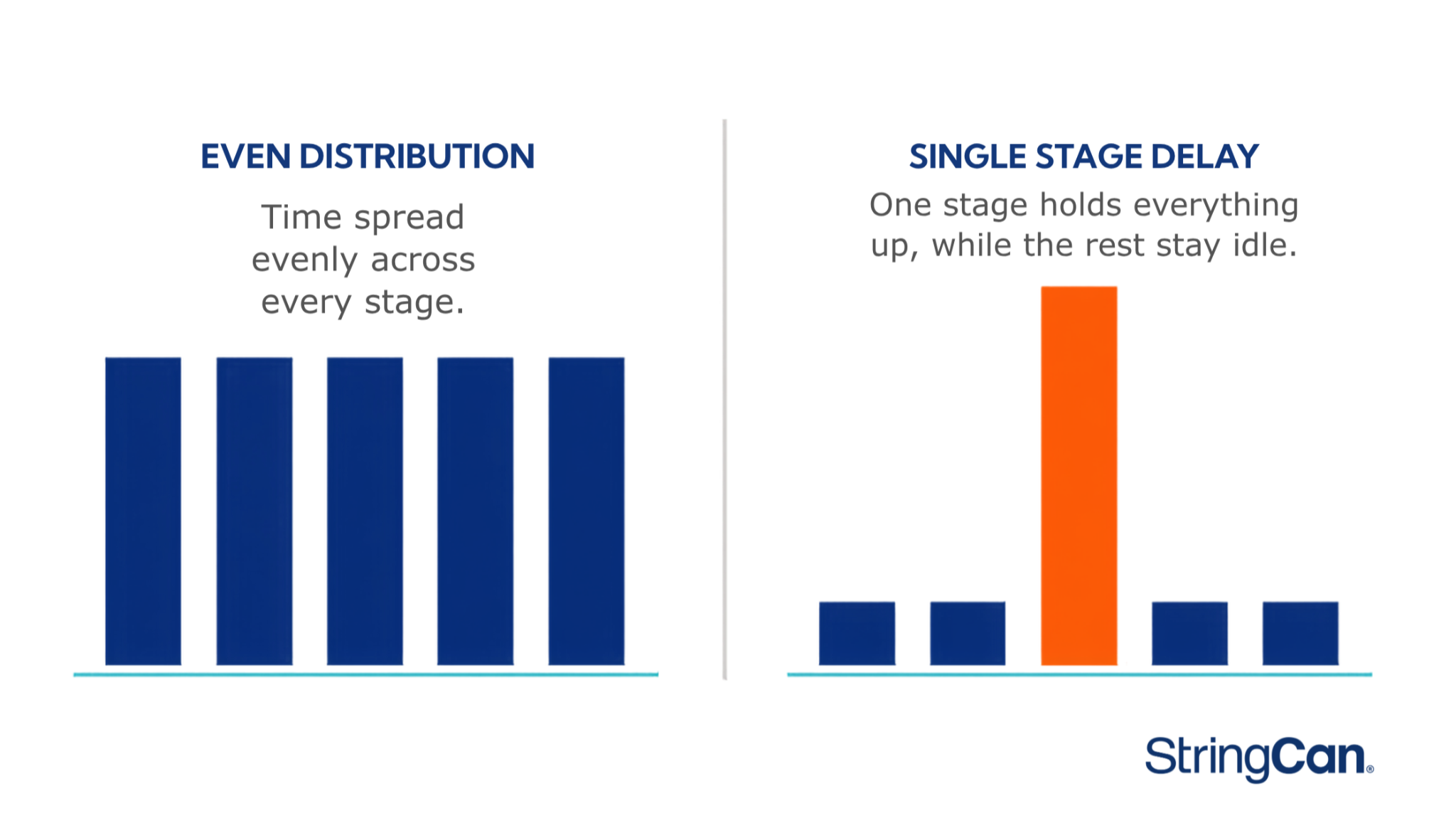
Average sales cycle length is a single number describing a process with five or six distinct steps. That's the whole problem. Averaging across stages is like taking the average temperature of a building and concluding the HVAC works.
Say your cycle went from 90 days to 118. Read as one number, that's a 31% slowdown, and it sounds like a market story. But if four of your five stages are running at the speed they always ran and one went from 12 days to 40, that isn't a market story at all. It's one broken gate, and a broken gate is narrow enough to fix in a week.
The report that would show you this isn't in most CRM defaults. Somebody has to build it, which is exactly why almost nobody has looked.
Two numbers to pull before your next pipeline review
You don't need a project for this. You need two figures per stage, and any modern CRM can produce both in an afternoon.
- Stage exit rate. Of the deals that entered this stage over the last two quarters, what percentage have left it in any direction, won, lost, or advanced? The ones still sitting there are your problem.
- Median time in stage. Use median rather than average. A handful of ancient deals will distort an average badly enough to hide how the middle of your pipeline is actually behaving.
Then run these questions across the results:
- Which stage has the lowest exit rate?
- Which stage has the longest median time in stage?
- Are those the same stage? If they are, stop looking. That's your leak.
- What percentage of open pipeline dollars is parked in that stage right now?
- What's the written criterion for leaving that stage, and can two reps state it the same way?
That last question usually ends the debate. When a stage has no shared definition of what finishing it means, deals accumulate there by default. It isn't a discipline problem, and it isn't a motivation problem. It's a design problem, and it's yours to fix.
What to fix, and what not to fix first
The reflex when close rates soften is to work on selling. More coaching, a sharper deck, discovery training, sometimes a new hire. Any of that can be reasonable, and none of it addresses a stage with no exit criteria, because you can't coach a rep past a gate nobody ever defined.
The second reflex costs more. Leadership decides the shortfall is a top-of-funnel problem and asks marketing for more leads. Now you're pushing volume into a pipeline that can't clear its own middle. That's the Volume Trap running downstream of a CRM Swamp, and it's the most expensive version of this mistake because it burns budget on top of time.
The actual fix is mechanical. Write the exit criterion down as an observable event, not a status. "Buyer confirmed budget and named the internal approver" is a criterion. "Proposal sent" is a status. Then set an age trigger: any deal past the median time in that stage gets one of three dispositions at the next review, advanced with evidence, pushed with a specific date and a reason, or closed lost. There's no fourth option.
The first month is uncomfortable because your pipeline value drops. It should. You're removing dollars that were never real. What you get back is a forecast leadership can trust and rep hours aimed at deals that can close. In the Revenue Flow methodology, this sits squarely in
Accelerate, where you fix the leak before adding activity. Running it the other way around is how B2B companies end up with a larger version of the same problem.
FAQ
What is a normal B2B sales cycle length?
There isn't a useful benchmark, and hunting for one is a distraction. Cycle length swings enormously with deal size, industry, and buying committee size, so a published average tells you close to nothing about your business. The number that matters is your own trend broken out by stage. Compare this year's median time in each stage against last year's. That comparison is actionable. A benchmark isn't.
What is stage exit rate and how do I calculate it?
Take every deal that entered a given stage over the last two quarters. Count how many have since left it in any direction, won, lost, or advanced, then divide by the total that entered. A stage where 90% of deals have moved on is working normally. A stage where 55% are still sitting there is absorbing your pipeline, and the deals inside it are older than your report suggests.
Why are my deals stuck in the proposal stage?
Usually because proposal is defined by something your team did rather than something the buyer committed to. Sending a document is an action you control. It proves nothing about budget, authority, or a decision date. When entry into a stage depends on your own activity, deals enter easily and leave slowly. Rewrite the criterion around something the buyer has to do.
Is a longer sales cycle a sales problem or a marketing problem?
Inspect before you assign it. If cycle time grew evenly across every stage, look at market conditions and deal mix. If it grew in one stage, that's a process issue inside sales and more leads won't touch it. If it grew in the earliest stages, lead quality is worth a hard look. The order matters, because asking marketing for volume while the middle of the pipeline is clogged makes the problem more expensive, not less.
If you can't pull stage exit rate for your pipeline in under ten minutes, that's already the finding.
Take the Revenue Leak Finder. If your result feels familiar, send it to me, and I'll tell you where I'd inspect first.