
You hired an agency because they talked like strategists. Four months in, they're fixing your one-page sales flyer, your CEO wants to know what the retainer is buying, and you're not sure if the problem is them or you.
My co-host, Sarah Shepard, StringCan Interactive's COO and my co-author on the Revenue Rewired book, asked me to get candid about why these partnerships break, including the ways agencies like ours cause it. You'll come away knowing the two root causes behind nearly every agency breakup and how to challenge a client's assumptions using data instead of opinion.
This post is based on Episode 82 of Revenue Rewired | Strategic Partner or Task Shop? What Clients Should Know Before Hiring an Agency. If you'd rather listen than read, find the full episode on Apple Podcasts, YouTube, Spotify, or Amazon. It's worth your time.
Why do so many agency-client relationships fall apart?
We're in year 16 at StringCan Interactive, and when I look back at the rocky relationships, ours and the ones other agency owners have shared with me, nearly every one traces back to communication or alignment. The agency thinks it understands the client's needs, the client assumes it does, and neither is quite right. Small misunderstandings stack up like a house of cards until something falls over.
Sarah added a piece I hadn't put into words. In our own quarterly planning, people tend to remember the last 30 days of a 90-day quarter, and plenty of changes in the other 60.
She called it themind-reader expectation. Clients assume their outside team is tracking everything happening inside the business, which isn't realistic unless the client helps filter the signal from the noise.
How does a rushed sales handoff set up an agency to fail?
I oversee business development here, so when a relationship goes sideways, I usually trace it back to questions I didn't ask. The prospect hears all the right things, everyone rushes to sign, and client services inherits a messy baton. These days, I treat it like dating, with three or more real conversations before we get near a contract.
A couple of weeks ago, on a second call with a prospect, I realized they wanted to pour roughly 80% of their budget and time into a new offering, bringing in maybe 2 to 3% of their forecasted revenue. Meanwhile, their team kept complaining about an enterprise HubSpot setup they couldn't even segment in.
I suggested fixing the CRM in parallel with the launch, since layering new offerings on a shaky foundation turns everything into a bowl of spaghetti. They were uncomfortable for a minute, and then it became one of the reasons they got excited about working with us.
How should a strategic partner push back without saying no?
I try to avoid the word no, because shutting an idea down kills the chance to understand why the client wants it. When something sounds off, I keep peeling the onion, then lay out a good, better, best set of choices.
When neither of us is 90% sure something will work, I'll suggest a pilot. Instead of committing $100,000 a month to a new campaign for a full year, we might propose three months at $25,000 per month.
The bigger move is letting the data deliver the bad news. One client's salesperson was presenting a 52% lead-to-close rate, more than double their industry norm, pulled from a narrow window with outliers removed.
A larger data set over a longer time frame put them near the industry average. We met with the salesperson first so they wouldn't be blindsided, then walked the client through it together.
What should you ask an agency before you sign?
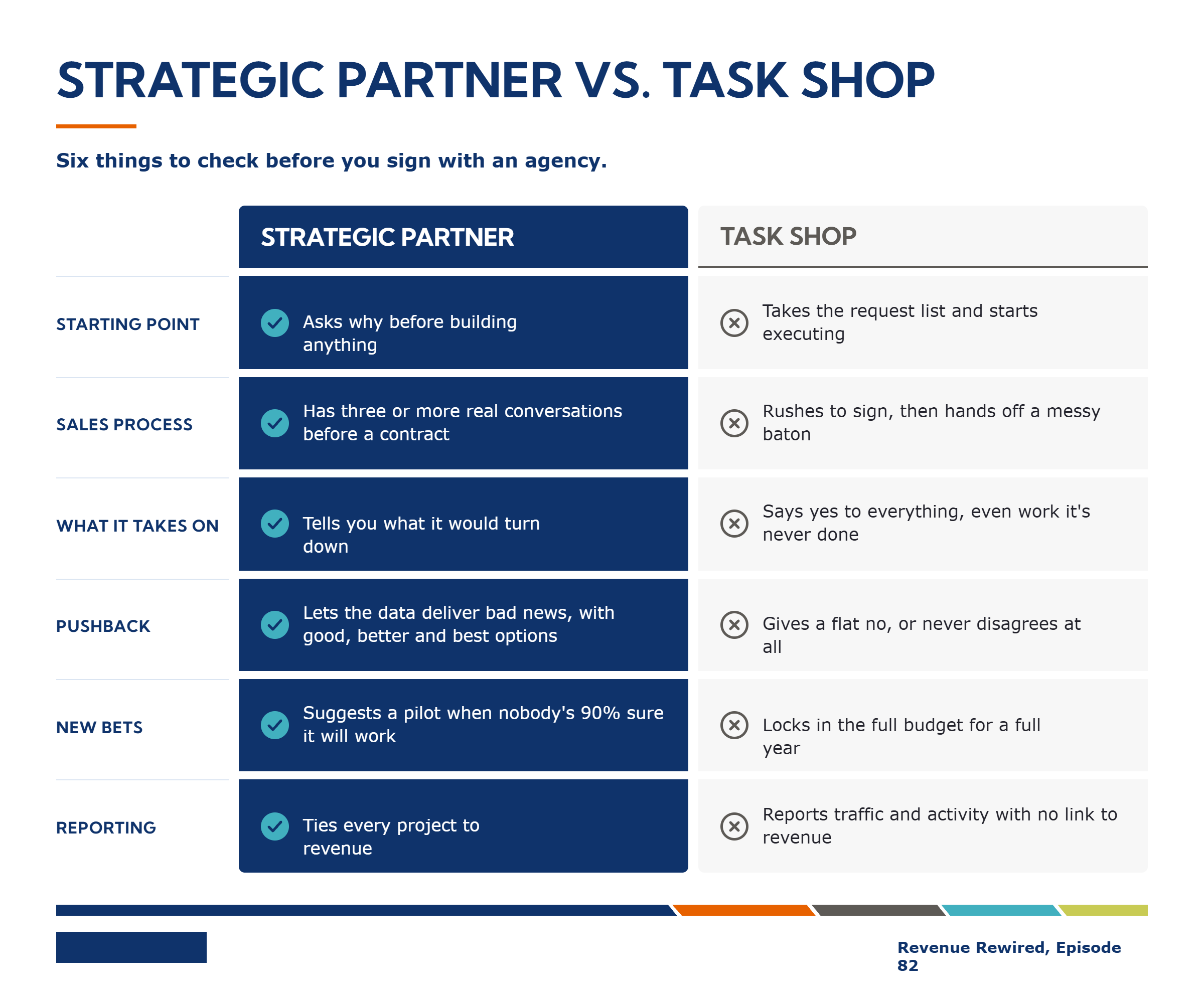
Communication and alignment sound abstract until you're the one interviewing agencies. These are the conversations I'd push for before signing anything:
- Ask what they'd say no to. If they'll take on a trade show with zero trade show experience, you're about to become their guinea pig.
- Get scope details in writing. One client balked at paying for two website design themes until we explained that a single theme leaves nothing to compare when it misses.
- Ask how they report results. Traffic up 12.2% means nothing if nobody can say what revenue came from it.
- Ask what happens when things go quiet. When a client gets distant, I'd rather sit down one-on-one, ideally in person, than assume silence means everything's fine.
Sarah's favorite line from the episode was that humans buy from humans, and I think that's the whole filter. If an agency can't have a hard conversation with you during the sales process, it probably won't have one six months in either.
Ready to work with a partner who pushes back?
If you want a partner that asks the uncomfortable questions before the contract and ties every project to revenue, contact us and let's talk about where your growth is getting stuck.
FAQ
Q: What's the difference between a strategic marketing partner and a task shop?
A: A real partner asks why before building anything and connects the work to revenue goals. Task-focused shops take the request list and start executing, which feels fast until results don't move the business.
Q: Why do agency partnerships usually fail?
A: In our experience, it comes back to poor communication or misaligned goals, expectations and timing. Small misunderstandings pile up quietly until trust breaks.
Q: How do I know if a marketing agency is overpromising?
A: Watch for one that says yes to everything, including work it's never done. Ask for examples of similar projects and what it would turn down.
Q: Should my agency push back on my ideas?
A: Yes, and a good one will do it with data and options rather than a flat no. When your agency never disagrees with you, you're paying for execution without the thinking.